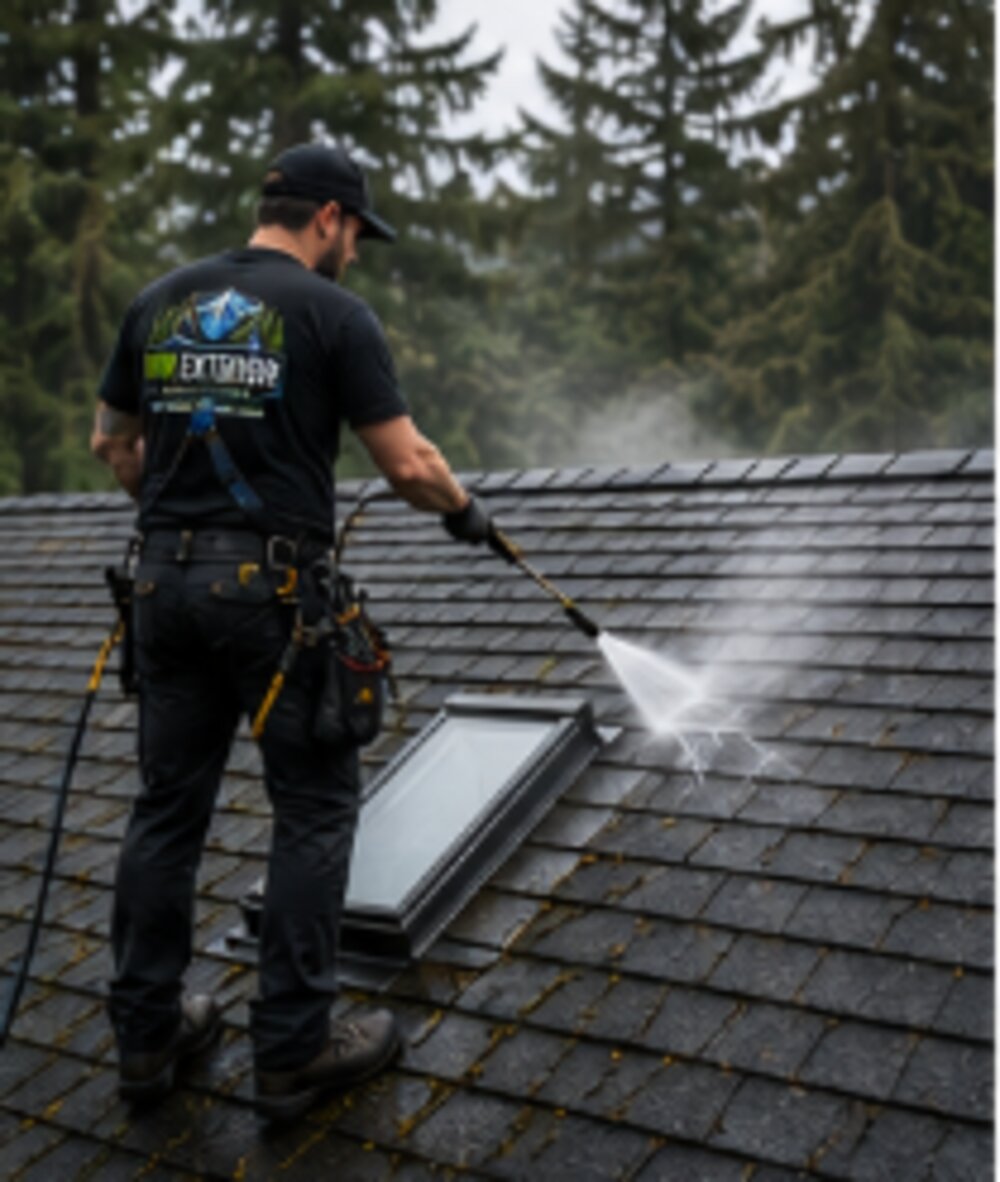
Soft washing is eco-friendly because it cleans with low pressure and biodegradable, plant-safe solutions instead of brute force. It kills moss and algae at the root, uses a fraction of the water a pressure washer burns through, and leaves runoff mild enough for the lawns, garden beds and storm drains that surround almost every Portland-area home.
What soft washing actually is
A pressure washer relies on force. Three thousand PSI or more, aimed at a surface until the growth gives up. Soft washing flips that equation. We drop the pressure to roughly garden-hose level and let the cleaning solution do the work — it dwells on the surface for several minutes, breaks moss, algae and mildew down at the cellular level, and then rinses away.
The environmental problem with high pressure is that force is the wasteful part of the job. It demands volume. It strips roofing granules, cedar fibers and paint into your gutters and flower beds. And it only shears the top off organic growth, leaving the root structure to regrow by next spring. If you want the full side-by-side, we covered it in soft washing vs. pressure washing.
Less water — a lot less
A contractor-grade pressure washer moves roughly four gallons a minute and runs almost continuously. A soft wash rig applies solution at a fraction of that flow and spends most of the job dwelling rather than spraying. On a typical single-story roof, that difference adds up to hundreds of gallons saved in one afternoon.
That matters more here than in most of the country. Storm drains across the Portland metro carry untreated runoff straight to the Willamette, the Tualatin and their tributaries. Whatever leaves your roof in November is in a creek shortly after. Cutting both the volume and the harshness of that runoff is the single most meaningful thing an exterior cleaner can do locally.
What is actually in the solution
Homeowners are usually surprised at how plain the recipe is. A professional soft wash mix is mostly water, plus:
- A dilute cleaning agent that oxidizes organic growth — chemically the same family used to sanitize municipal water and swimming pools, at a working strength well below what you would find in a pool
- A biodegradable surfactant so the mix clings to a pitched roof instead of sheeting straight into the gutter
- A neutralizing rinse, and on landscaping-heavy properties, plant-safe additives
The point most people miss is what happens afterward. The active ingredient breaks back down into salt and water once it has done its job. It does not build up in soil the way petroleum-based degreasers do — or the way the granular zinc and copper "moss killer" products sold at big-box stores do. Those leach a little more metal into your beds with every rain, all winter long.
How we keep it off your landscaping
Eco-friendly is a method, not a bottle. Most of the protection comes from technique:
- Pre-soaking lawn, beds and shrubs with clean water so nothing can absorb solution
- Tarping or bagging sensitive plantings directly below the work zone
- Mixing to the weakest dilution that will still do the job — stronger is not better, it is just harsher
- Rinsing continuously as we move, not once at the end
- Scheduling for a mild, dry window so nothing dwells longer than intended
West-side homes make this especially worth doing right. Around Forest Grove, Cornelius and Gaston, mature Douglas fir canopy keeps north-facing roofs damp for most of the year, so growth is heavy and the surrounding plantings are usually established and expensive to replace.
What about the roof itself?
Asphalt shingle manufacturers have pointed at low-pressure chemical cleaning for years, and most warranties are void if a roof has been pressure washed. So the gentle method is also the one that keeps your coverage intact. That is a rare case where the greener choice is also the financially safer one.
The greenest wash is the one you need less often
Because soft washing kills growth at the root rather than knocking off the visible layer, results last two to three times longer than a blast-and-go cleaning. Fewer visits means less water, less product and fewer truck trips over the life of your roof.
The bigger win is further out. Moss that sits on a PNW roof holds moisture against the shingles and lifts their edges, and a roof that fails early sends two to three tons of asphalt to a landfill. Keeping a roof clean is one of the few maintenance tasks where the environmental math and the household budget point the same direction.
Curious what a soft wash would run for your home? Get a free instant quote — and right now you can take 30% off your first service.
Eco-friendly soft washing across the Portland metro — 30% off your first wash.
Claim My 30% Off