
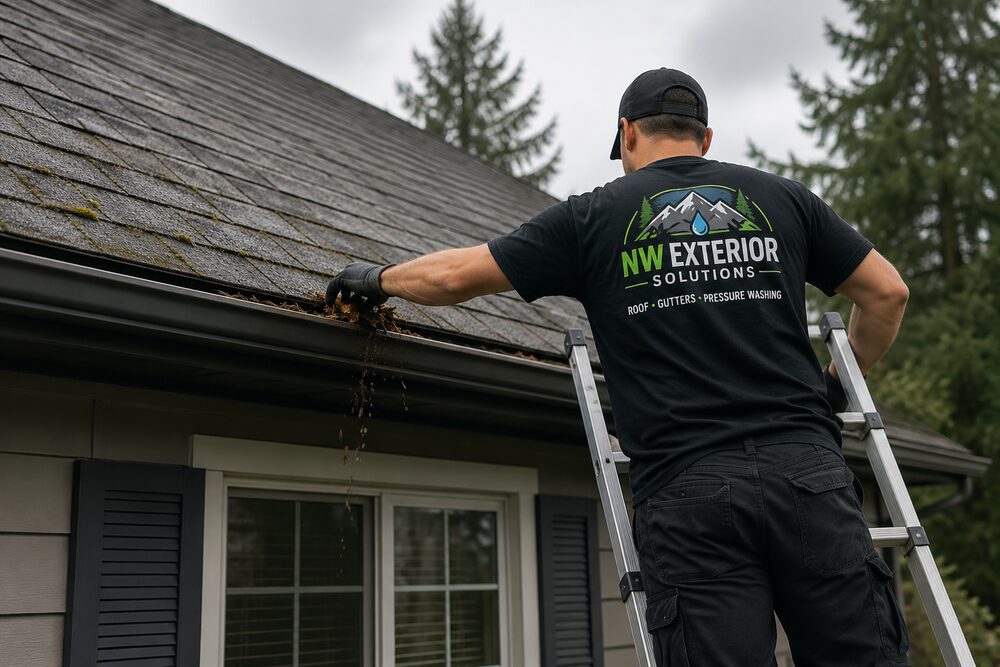
Portland-area gutters should be cleaned at least twice a year, and the most important cleaning is late October through mid-November, right after the maple and Douglas fir drop ends and before the heavy winter rain settles in. Clogged gutters overflow, soak your fascia and siding, and feed moss and rot.
Why Portland gutters clog faster than you think
Our region is tough on gutters. Big-leaf maples drop huge, wet leaves that mat together like felt. Douglas firs and cedars shed needles that pack into downspout elbows. Add shingle moss that sloughs off in the rain, and a gutter can go from clean to clogged in a single windy week. Homes under a mature tree canopy in Tigard, Lake Oswego and the West Hills often need attention more than twice a year.
Rain is the other half of the equation. With 36–40 inches a year, concentrated from October through May, a blocked gutter isn’t a minor annoyance here — it is water with nowhere to go but down your walls and into your foundation.
What actually goes wrong when gutters overflow
- Fascia and soffit rot. Standing water softens the wood behind the gutter, and replacement costs far more than a cleaning.
- Moss and algae on siding. Overflow runs down the wall and leaves green and black streaks right below the gutter line.
- Foundation and crawlspace moisture. Water dumped beside the house can seep into crawlspaces, which are already damp in our climate.
- Roof edge damage. Water backing up under the first row of shingles can rot the roof deck and lead to leaks.
- Pests and ice dams. Debris holds moisture that attracts mosquitoes and rodents, and on cold snaps it freezes and tears gutters off the house.
Signs your gutters need cleaning now
You don’t have to climb a ladder to spot trouble. Watch your gutters during a real rain. If water spills over the front lip, pours out of the corners, or the downspout runs weakly or not at all, there is a clog. Other giveaways include sagging sections, plants or small seedlings growing in the gutter, dark streaks on siding beneath the gutter line, and mulch or soil washed out beneath the downspouts.
The right gutter cleaning routine for the PNW
A good cleaning is more than scooping leaves. Here is what a thorough job includes:
- Remove all debris by hand, including the compacted muck at the bottom of the trough.
- Flush the gutters with water to confirm they slope properly toward the downspouts.
- Clear every downspout and check that the underground drain connection isn’t blocked.
- Inspect seams, hangers and fascia for leaks, loose fasteners and early rot.
- Wash the outside face of the gutters to remove the black “tiger stripes” of oxidation and algae.
Timing matters. If you wait until January, you’ll be cleaning in the worst weather, and the leaf mat will already have done its damage. A second, lighter cleaning in late spring clears seed pods and roof debris.
Gutters and your roof work together
Gutters and roofs share the same problem: moisture that never leaves. Moss on the roof sheds granules and clumps straight into your gutters, and clogged gutters keep the lower roof edge wet, which speeds up moss growth. Treating them as one system saves money. If you’re curious how roof cleaning is priced, see our Portland roof cleaning cost guide, and consider bundling both jobs on one visit.
DIY or hire a pro?
Cleaning gutters yourself is possible on a single-story home with a sturdy ladder and good footing, but ladder falls are among the most common home-maintenance injuries, and wet moss makes a roof edge slippery. Two-story homes, steep rooflines and tall trees are good reasons to call a professional. Our crews clean and flush gutters safely, check for early damage, and can wash the siding below while we’re there. If you’re in Tigard or nearby, see our Tigard exterior cleaning service page for what we offer in your area.
Don’t wait for the first storm to find out where your gutters leak. Get a free instant quote — and right now you can take 30% off your first wash.
Get a free instant quote — 30% off your first wash.
Claim My 30% Off