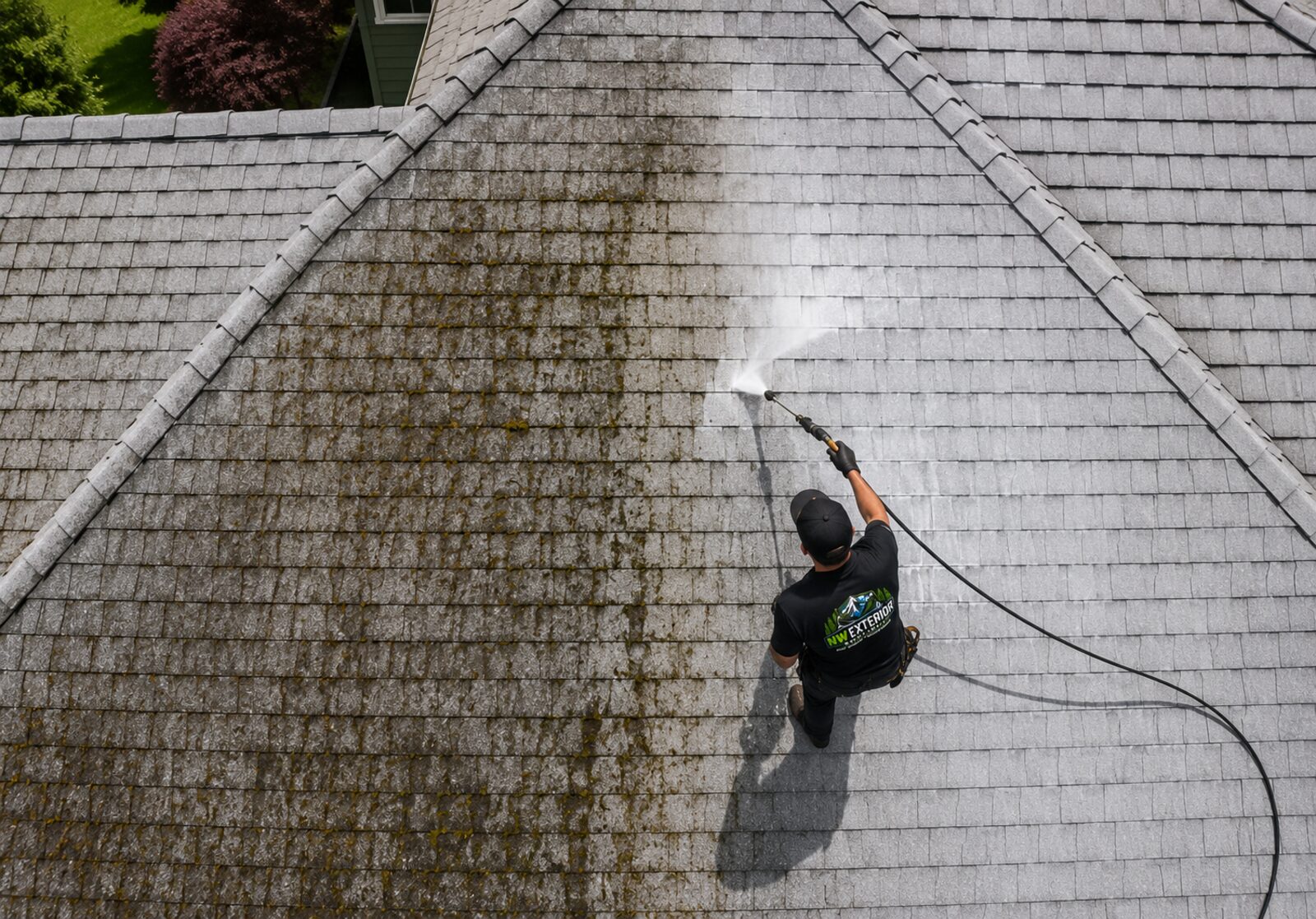
DIY roof cleaning is riskier than it looks because the three things that make it work — height, pressure and chemistry — are the same three things that cause the damage. Falls, stripped shingle granules, voided manufacturer warranties and killed landscaping are all common outcomes, and the repair almost always costs more than the professional wash would have.
Every spring we get calls from Portland homeowners who started the job themselves and stopped halfway. Usually the roof is streaked, half the moss is still up there, and something got damaged on the way. None of these were careless people. Roof cleaning simply punishes small mistakes in a way that washing a driveway does not.
1. The fall risk is the part nobody prices in
A wet, mossy Pacific Northwest roof is one of the most slippery surfaces you will ever stand on. Moss holds water for days after the rain stops, and on the north-facing slopes where it grows thickest the shade never lets the surface dry out between showers. Add a pressure washer hose that jerks sideways every time you squeeze the trigger and you have a genuinely dangerous setup.
Ladder and roof falls send tens of thousands of Americans to emergency rooms every year, and the serious ones happen on roofs. Professional crews carry harnesses, roof anchors and — the part homeowners rarely think about — liability insurance that covers the house if something goes wrong. If you come off your own roof, that is your medical bill and your problem.
The low-tech alternative most people miss
A lot of PNW roof work does not require standing on the roof at all. Soft-wash equipment reaches most single-story and many two-story roofs from a ladder at the eave or from the lawn. If a contractor tells you they will be walking your roof for the whole job, ask why — foot traffic on wet composition shingle causes granule loss all by itself.
2. Pressure washing a roof is a one-way decision
This is the most expensive DIY mistake we see, and it is not close. Asphalt shingles are protected by a layer of ceramic granules bonded to the surface. Those granules are the shingle’s sunscreen and a big part of its fire rating. A consumer pressure washer at 2,000-plus PSI strips them off in seconds — you will literally watch them run down the driveway in the rinse water.
The roof looks great that afternoon. Two summers later the exposed asphalt has dried, curled and cracked, and you are re-roofing years early. We can still see wand paths from the street on Portland roofs somebody cleaned this way half a decade ago. For roughly what a professional soft wash would have cost — our breakdown of what roof cleaning actually costs in Portland lays out the real numbers — those homeowners bought themselves a new roof instead.
3. The chemistry is easy to get wrong
Roof-cleaning solution is not just stronger bleach. Dilution, dwell time and rinsing all matter, and the right mix depends on what is growing and what it is growing on. The common failure modes:
- Too strong — kills the rhododendrons, arborvitae and lawn under the drip line, dulls painted gutter coatings and corrodes fasteners.
- Too weak — takes the surface growth off but leaves the rhizoids rooted in the shingle seams, so the moss is back within a season.
- Left to dry in the sun — the solution bakes onto the shingle and leaves permanent light streaks.
- No pre-wet, no post-rinse — far and away the most common cause of dead landscaping after a DIY wash.
- Wrong product for the surface — cedar shake, metal and tile each need a different approach than composition shingle.
Runoff matters here too. Everything you rinse off a roof in the Portland metro heads for a storm drain that feeds the Willamette or the Columbia Slough. Containing and diluting that responsibly is part of the job, not an afterthought.
4. You can void things without knowing it
Most shingle manufacturers spell out approved cleaning methods in the warranty, and high-pressure washing is excluded by essentially all of them. Some homeowners policies also treat self-inflicted roof damage differently than storm damage. Neither becomes a problem until the day you file a claim and find out.
What DIY genuinely is fine for
None of this means you should never touch your own house. Sensible, low-risk homeowner maintenance in this climate looks like:
- Keeping gutters and downspouts clear from a stable ladder at the eave
- Trimming branches that overhang the roof — less shade and less debris means slower moss growth
- Blowing fir needles and leaves off the roof surface from the edge, in dry weather
- Washing flat ground surfaces like driveways, patios and fences, where pressure is appropriate and you are not on a slope
Those four habits alone will meaningfully slow how fast moss returns. What they will not do is lift an established mat or stop the regrowth underneath it.
The honest math
A professional soft wash on a typical Portland home costs a few hundred dollars and takes part of a day. A rental pressure washer, chemicals, a decent ladder and a lost Saturday is not far off that number once you total it up — except it also carries the risk of an early re-roof, a dead hedge or a trip to urgent care. Laid out side by side, most homeowners would not take that trade.
If you are on the fence, get the quote first and decide afterward. We will tell you honestly whether your roof needs a full moss removal or just a maintenance treatment, and plenty of the roofs we look at need less than the owner expected. Request a free quote and take 30% off your first service.
Let us look at it first — free on-site quote, straight answer, 30% off your first wash.
Claim My 30% Off